


- Dive into the turquoise waters of the Sambangan waterfalls.
- Share a traditional Balinese meal, rural and simple.
- Discover the symbolism of the keben, a ceremonial bamboo basket.
- Learn how to weave and leave with a piece shaped by your own hands, full of meaning.
- Experience a day of nature, cooking, and cultural transmission.
From the Sambangan waterfalls to the gestures of Balinese weaving
North of Bali, this day combines walking, swimming, home-style cooking and discovery of a craft closely tied to Balinese religious life. It begins along the paths of Sambangan, between rice fields, plantations and tropical gardens, before reaching the waterfalls and their turquoise pools. A few hours in the fresh air, accompanied by a local guide who knows these trails inside out, offer a chance to discover another side of the island—more rural and rooted in everyday life.
The afternoon shifts pace and scenery. After the hike, head to a local family home to share a traditional lunch, then learn the art of weaving a keben. Behind this brightly colored bamboo basket lies an object deeply connected to Balinese Hindu ceremonies. Making it—even partially—offers a different way to understand its purpose and symbolism: through the gestures themselves, the craftswoman’s explanations, and the time spent together around the table.
Sambangan, between tropical trails and swimming in waterfalls
The morning begins on foot in the countryside of northern Bali. The path winds through clove plantations and tropical gardens before reaching the Sambangan waterfalls. Here, the landscape reveals itself gradually as you walk, accompanied by a local guide who knows the area and its trails inside out. The hike is as much a way to reach the waterfalls as it is a first immersion in this rural environment.
On arrival, the turquoise pools offer a welcome break. Everyone can enjoy the place at their own pace: some simply swim in the cool water, while thrill-seekers can try the natural slides or the different jumping spots. Nothing requires everyone to follow the same rhythm. It’s just as possible to stay by the water and enjoy the calm after the walk.
Back from the hike, the atmosphere becomes more intimate. Lunch is served in a local family home, with traditional dishes prepared that very morning using herbs from the garden. The table is simple, and conversation flows naturally. This meal is not designed as a spectacular interlude, but as a shared moment in the family’s everyday setting. It gently opens the second part of the day, devoted to a craft whose significance goes far beyond that of a simple decorative object.

In the family home, learning the movements of keben-making
The house does not try to transform itself to welcome visitors. Concrete, packed earth, a garden, animals moving freely between the courtyard and the living areas: the setting remains that of everyday life. This simplicity immediately sets the tone. Tea and a few snacks are placed on the table while the craftswoman prepares her materials. The workshop can begin without any particular staging, in a relaxed, family atmosphere.
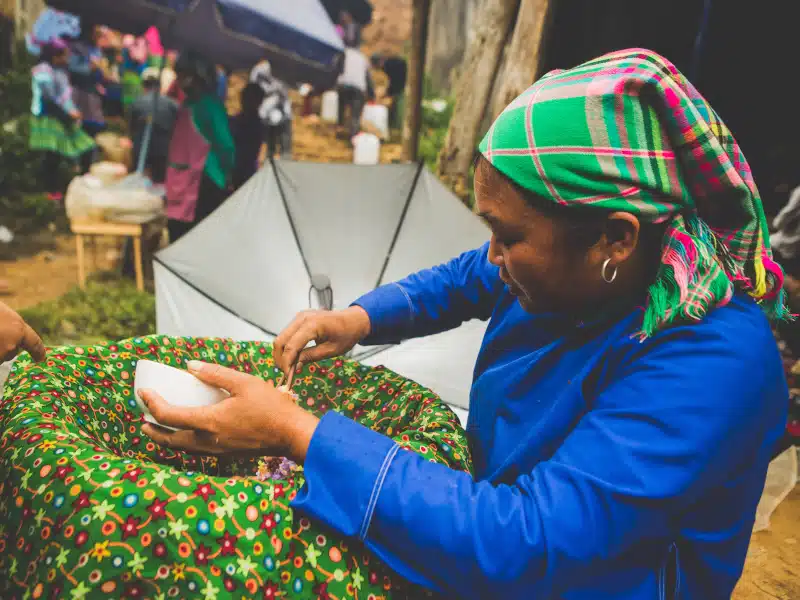
She has been weaving since her teenage years. Her hands move quickly, with the precision that comes from gestures repeated for years. She first presents the thin bamboo strips tiing tali used to make the baskets. They are heated to soften them, then dyed in the bright colours characteristic of these pieces. Watching the demonstration is enough to gauge the technical skill involved: the movement looks simple when performed with such ease—much less so when it’s your turn to try it yourself.
Very quickly, though, any apprehension fades. Everyone chooses their colours, sits around the table and begins to weave, guided step by step by the craftswoman. Her hands correct a movement, take back a strip, show a section again. Languages mingle, smiles fill in the gaps, and learning naturally takes the form of an exchange. You leave with a piece shaped by your own hands, but above all with a more concrete understanding of the object you have just made.

The keben, much more than a woven basket
Because the keben is not just a craft item. In Balinese Hinduism, it is a ceremonial object used, in particular, to carry the elements needed for offerings. Its name comes from the Balinese word engkebin, “to hide”. Its fitted lid helps preserve the privacy of what is carried to the temple: whether the basket contains simple bananas or more precious fruit, its contents remain unseen. Sing ada nak nawang: no one will know. The religious act can thus remain free from comparison and judgement.
Inside the keben is often what will be used to make a canang sari: flowers, rice, holy water, or incense. These daily offerings, placed at the entrances of homes, shops and temples, play a central role in Balinese Hindu practice. They are part of an idea of gratitude and giving—something that simply looking at a finished basket would not necessarily convey.
These explanations come throughout the workshop, without interrupting the work. The craftswoman talks about her pieces, their function and their presence in ceremonies while the bamboo strips take shape between her fingers. It is this link between a craft gesture and the object’s living use that gives the encounter its full meaning. The keben brought home at the end of the day is then no longer only what you have learned to weave: it remains associated with a home, a face, a few patiently passed-on movements, and the story that gives them meaning.


 Français
 English


